
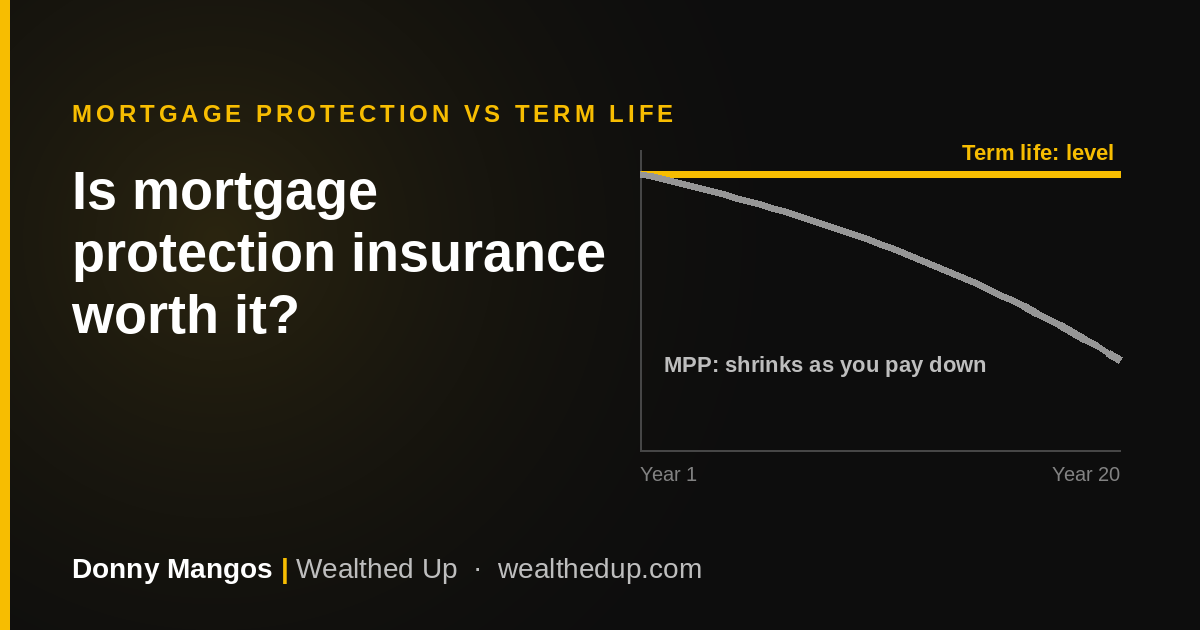
Short answer: For most healthy Canadians, a standalone term life policy is a better way to protect a mortgage than mortgage protection insurance (MPP). The MPP benefit shrinks as your balance falls while your premium stays the same, it is applied to the mortgage rather than paid to your family, and it ends when the mortgage does. In the Manulife quotes below, a level term policy costs about $10 a month less than MPP for the same couple (Term 65), or about 46% less if the plan is to reduce or drop coverage after 20 years (Term 20). MPP can still make sense if a health issue makes term hard to get, and it is the only option here that includes disability cover.
What is mortgage protection insurance, and who sells it?
Mortgage protection insurance is group life insurance, with an optional disability benefit, offered alongside a mortgage. Manulife's Mortgage Protection Plan (MPP) is a common example. The mortgage broker holds the master policy and the borrower receives a certificate under it. The brochure says so directly: the broker is the group policyholder, and "your mortgage broker is not a licensed life insurance agent."
So the insurance is arranged at the mortgage table by someone who is not licensed to advise on it. That is not a knock on mortgage brokers, who are experts at mortgages. It is the reason this decision deserves a second opinion from a licensed advisor. It is also optional. The application itself says so.
Why does mortgage protection coverage shrink while the premium stays the same?
The MPP life benefit is calculated on a traditional mortgage that steadily declines. As the balance drops, so does your coverage. Your premium, meanwhile, is locked in at the age you applied.
Take a $425,000 mortgage on a 25-year amortization at an illustrative 5%. The balance is about $314,000 after 10 years, $234,000 after 15 and $132,000 after 20. Same premium, a fraction of the protection.
Does paying my mortgage down faster hurt my mortgage protection coverage?
Yes, in effect. Most good financial advice says to pay the mortgage down faster: lump sum prepayments, accelerated payments, a little extra every month. MPP works against you when you do. The benefit is capped at the amount you still owe, so every extra dollar you put on the mortgage takes a dollar off your coverage. The premium does not move. Prepay $50,000 and you are paying the same monthly premium for $50,000 less protection.
The family doing exactly the right thing with its mortgage ends up paying more and more per dollar of coverage. Meanwhile, their needs have not shrunk at the same pace. Kids still need to be raised and income still needs to be replaced.
A level term policy does not care how fast you pay down your mortgage. The benefit is the same whether you owe $425,000 or $50,000. If you finish early, you still have the coverage your family needs, or you can let it go. Your choice.
Who gets the money when mortgage protection pays out?
MPP "pays off or reduces your mortgage balance." That is the entire job. Paying off the mortgage is a good outcome, but it may not be the best one. Your family might need the cash for income replacement, childcare or keeping a low-rate mortgage in place. Term insurance pays a tax-free lump sum to the beneficiary you name. They decide what to do with it.
How long does mortgage protection last?
MPP life coverage ends at age 70 and disability coverage at 65. It also ends when you no longer have the mortgage, when the initial amortization ends, or if premiums go 31 days overdue. It is tied to the debt, not to your life. With term, you choose the length, and most term policies can be converted to permanent insurance later.
What can go wrong at claim time?
MPP applications ask health questions. The brochure warns that if you provide incomplete or inaccurate information, your insurance may be void and "no benefits may be paid for any reason." If a required tele-interview is not completed within 30 days, you get accident-only coverage. Disability claims carry a pre-existing condition exclusion for the first 12 months.
An individual term policy is underwritten up front. In Canada, individual life policies generally cannot be contested after two years, except in cases of fraud. You know where you stand before you ever need the policy.
What does standalone term life do differently?
- Level coverage. $425,000 stays $425,000 for the whole term.
- You choose who gets paid. A named beneficiary receives the money, generally tax-free.
- It is yours. Switch lenders, refinance or sell the house, and the policy does not change.
- It is convertible. Most term policies can be converted to permanent coverage without new medical evidence.
- It is underwritten once, up front. No surprises at claim time.
How do the costs of mortgage protection and term life compare?
Here is a real side by side. The couple is 39 and 38 with a mortgage of approximately $425,000, and each person is insured for $425,000. MPP premiums are from a Manulife MPP quote (life cover only, provincial sales tax included). Term premiums are from Manulife Family Term illustrations at a mid-range health rating (Healthstyle 3), run in October 2026. Your premiums will differ.
| MPP (life only) | Term 65 | Term 20 | |
|---|---|---|---|
| Monthly premium, both people | $118.78 | $108.70 | $64.00 |
| Monthly premium after year 20 | Unchanged | Unchanged | $795.80 |
| Benefit per person, year 1 | $425,000 | $425,000 | $425,000 |
| Benefit per person, year 10 | about $314,000 | $425,000 | $425,000 |
| Benefit per person, year 20 | about $132,000 | $425,000 | $425,000 |
| Paid to | The mortgage | Your named beneficiary | Your named beneficiary |
| Coverage ends | Age 70, or when the mortgage ends | Age 65 | After 20 years, then renews |
Two things to take from this.
Term 65 is cheaper than MPP and gives you more. It runs about $10 a month less, holds the same level benefit for 26 years, and covers a standard 25-year amortization. The savings are modest. The real difference is what you get for the money: a benefit that never shrinks.
Term 20 is the budget route. At $64.00 a month it costs about 46% less than MPP, roughly $13,100 less over 20 years. But renewing the full amount at year 21 costs $795.80 a month. This option works when the plan is to reduce or drop coverage once the balance has come down. That is a conversation to have on day one, not at renewal.
The balances in the table assume a 25-year amortization at an illustrative 5%, not any particular mortgage. The MPP quote includes provincial sales tax and the term illustrations do not. Both are what the client would actually pay.
When does mortgage protection make sense?
MPP is not always the wrong answer. Two situations deserve a fair hearing.
Health issues. MPP's application is simple, and Manulife says every eligible applicant is approved for some level of protection, even if only for accidents. If you have a significant health history, a standalone term policy may be rated up or declined, and MPP may be the door that is open. MPP also includes a terminal illness benefit and a waiver of premiums for up to three months after an involuntary job loss.
Disability. Term life does not cover disability, and MPP does: up to $10,000 a month for a maximum of 24 months after a 60-day wait. If you want that protection, price an individual disability or critical illness policy separately. It is a different conversation, and it deserves its own plan, not a checkbox at closing.
Mortgage brokers: why refer mortgage protection and term life to a licensed advisor?
You are great at mortgages. Most brokers are not licensed to advise on life insurance, and Manulife's own brochure tells the client so. When a client asks "should I take the mortgage insurance?", you are being asked a question you cannot answer. Here is what changes when you send it to me:
- You stop giving advice you are not licensed to give. The question goes to someone who is.
- Your client gets better coverage. Level, portable and payable to their family. That is what they will remember at renewal and when they refer friends.
- Nothing for your team to chase. I handle the application, underwriting, medical requirements and paperwork, and keep you in the loop.
- You stay the mortgage expert. I do not do mortgages. I protect the ones you arrange.
- No re-do at renewal. The policy is independent of the lender, so refinancing or switching does not trigger another insurance conversation.
- You look like the broker who thinks beyond the rate. Because you do.
Introduce me early, ideally when the file goes to the lender. Term underwriting is not instant, and you want the coverage in place at closing.
Related questions people ask
Is mortgage protection insurance worth it in Canada?
For many healthy buyers, no. The benefit falls as your mortgage balance falls while the premium stays locked, the money is applied to the mortgage rather than paid to your family, and coverage ends when the mortgage does. A standalone term life policy usually keeps a level benefit for a similar or lower price. Mortgage protection can be worth considering if a health condition makes term insurance hard to get, or if you want the disability cover that term life does not include.
Is mortgage protection insurance mandatory?
No. The Manulife Mortgage Protection Plan application states that the insurance is optional, and you can decline it. Review any mortgage insurance offer carefully before you sign, and you are free to arrange life insurance separately with a licensed advisor.
Can I cancel mortgage protection insurance?
Yes. Manulife's brochure says you can review your coverage for 60 days and, if you change your mind in that period, you get your money back less any claims paid. After that you can still cancel by contacting the insurer. Coverage also ends if you pay off the mortgage and do not replace it.
How much term life insurance do I need to cover a mortgage?
At a minimum, enough to clear the mortgage balance. Most families also need to replace income, fund childcare and education, and cover other debts, so the right amount is usually higher than the mortgage alone. A needs analysis with a licensed advisor turns that into a number for your household.
Is a term life insurance payout taxable in Canada?
Life insurance death benefits paid to a named beneficiary are generally not taxable income in Canada. The beneficiary receives the money as a lump sum and decides how to use it. Tax rules can change and individual situations differ, so confirm details with your own accountant.
What happens when my term life policy ends?
You can usually renew it, convert it to permanent insurance, or let it end. Renewal premiums are higher because you are older. In the Manulife Term-20 quote in this article, the premium for a couple rises from $64.00 to $795.80 a month after year 20. That is why the plan should be set on day one: either reduce or drop the coverage as the mortgage balance falls, or choose a longer term such as Term 65.
Does term life insurance cover disability?
No. Term life pays only on death. Mortgage protection plans such as Manulife's include a separate disability option, which pays up to $10,000 a month for a maximum of 24 months after a 60-day wait, with exclusions. If you want disability protection, price an individual disability or critical illness policy separately and compare it on its own merits.
Want to see the numbers for your mortgage?
Book a call and I will run a mortgage protection vs term comparison for your situation. If mortgage protection is the better fit, I will say so. Mortgage brokers: send me a client and I will show you what the comparison looks like.
Book a call with DonnySources and notes: Manulife Mortgage Protection Plan brochure and application (MP6098593E, 08/25); Manulife Family Term illustrations dated October 26, 2026 (Term-20 and Term-65, combined coverage, two lives, Healthstyle 3). Figures are illustrative, premiums and eligibility vary by individual, and terms can change. The MPP certificate and your policy contract govern. This article is for educational purposes only and is not financial, tax, insurance or legal advice. Always consult a licensed advisor about your situation.